

Lucky or Blessed?

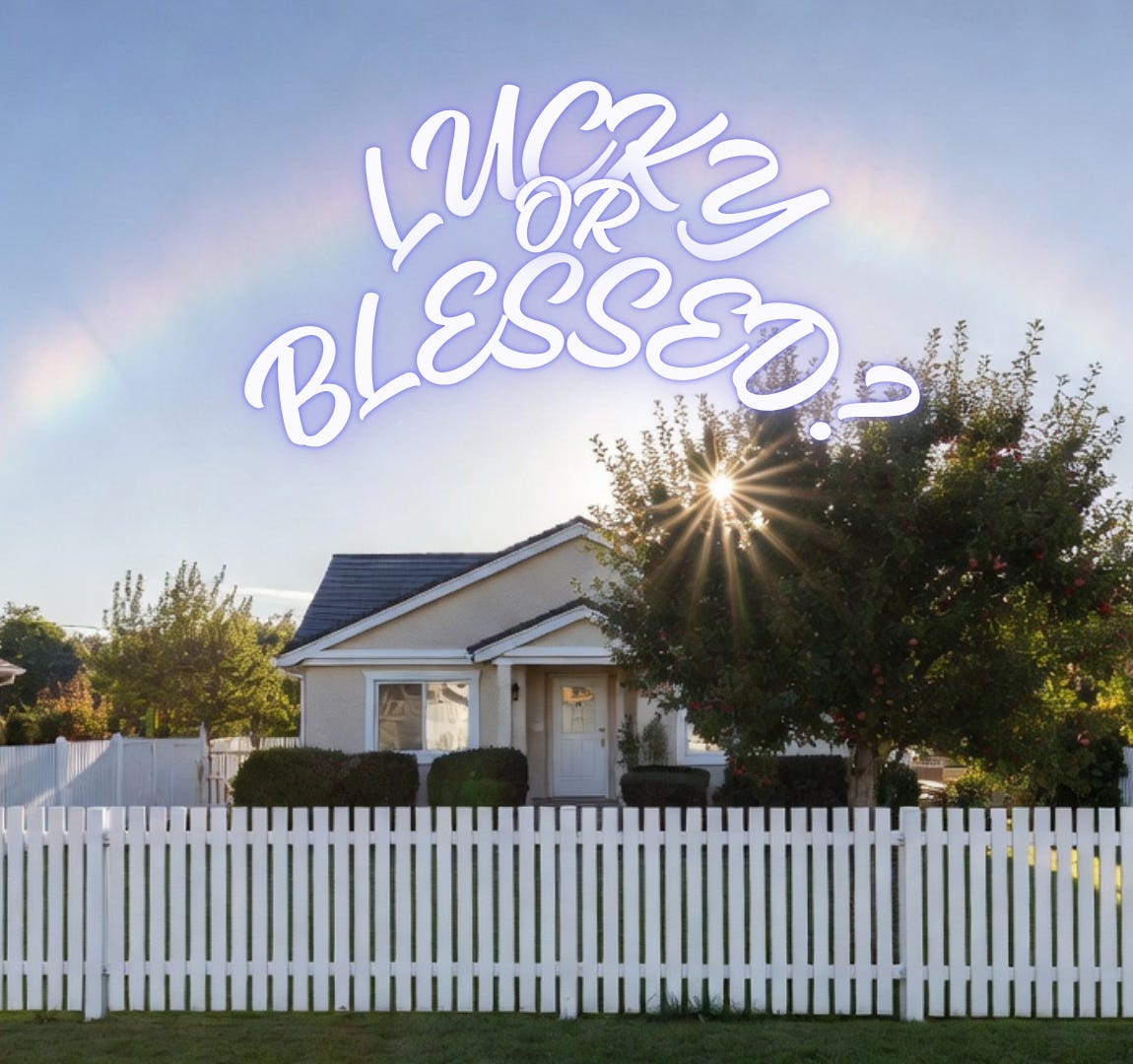
Over time, we come to understand that we experience the Lord's blessings when we sleep, simply because we are able to sleep.
In the same way, we experience in our relationships the truth that the Lord's blessings add no sorrow to our lives.
The thing that I want to consider with you today is the word “blessed.” The word “blessed” is mentioned 302 times in the King James Version of the Bible. Somebody say “blessed.”
How many times have we heard someone say, “I’m blessed,” or “Pray that the Lord will bless me”? When we look closely at the word “blessed,” we see it appears 302 times overall, but specifically in the Book of Psalms it is mentioned 47 times.
In Genesis chapter 12, the Lord speaks a foundational promise of blessing to Abraham: “I will make of thee a great nation, and I will bless thee, and make thy name great; and thou shalt be a blessing. And I will bless them that bless thee, and curse him that curseth thee: and in thee shall all families of the earth be blessed.”
This is a foundational, covenantal blessing that was originally given to Abraham.
It became a generational blessing that was passed down to his natural descendants. Because we are the spiritual seed of Abraham through faith in Jesus Christ, this same blessing is attributed to us and is possible for us today.
The Lord has made this clear promise: “If you will be faithful, I will bless you, and I will cause you to be a blessing to others.
”When we examine the word “blessing” throughout the Bible, we discover there are two primary ways it is used. One way is when we say,
“I will bless thee, O Lord,” which speaks of our praise and worship directed toward the Lord.
Approximately 250 times when the words “blessed” or “blessing” appear in the Bible, they refer to us blessing God. Think about this for a moment. How can I—who am mortal, temporal, weak, flawed, and imperfect—how can I in any way be a blessing to the Creator of all things?
Yet the Bible instructs us to bless the Lord about five times more frequently than it promises that the Lord will bless us.
The promise far outweighs the admonition. You cannot bless God more than God can bless you. It is similar to a minimum-wage worker who works for a billionaire. The worker can have good wishes and kind thoughts for the billionaire, but the billionaire has the power to be a true game-changer in the worker’s life.
The worker cannot change the billionaire’s life in any significant way. In an even greater measure, when we speak of wishing, praying, blessing, and worshiping God, it reveals a fundamental understanding: we are not the same. I am not God, and God is not a man. In any honest calculation, God does not need me, but I desperately need God.
The marvelous and wonderful thing to consider is that God still wants me. God wants you.
This morning as we think about this idea, consider the concept of luck. There are all kinds of songs that include the word “luck.” There are all kinds of storylines in novels and movies built around luck. We are all familiar with it. We say things like “I got lucky and found a close parking spot.” We have all had a tendency at times to view certain events as lucky.
I would say to you that there really is no such thing as luck. There is time and chance, yes, but the blessing of the Lord is something entirely different. One of the most common Hebrew words used for when God blesses us sounds like “asher.” When we talk about God blessing us, it speaks of being happy, feeling fortunate, and being supremely blessed.
We read, “Blessed is the man that trusteth in the Lord.” You find this promise of being blessed throughout the pages of the Bible.
In contrast, the Hebrew word that describes us blessing God is “barak,” which means to kneel, to worship, and by extension to bless, to praise, and to invoke favor. This concept of blessing is not simply an Old Testament subject; blessing is also a New Testament reality.
The Greek word for blessed is “makarios,” which means supremely blessed or happy and often refers to the inner state of those favored by God.
This Greek word is translated as “blessed” 44 times and as “happy” 5 times in the New Testament. There is a clear and beautiful connection between blessing and joy. You have probably heard me say this before:
I do not believe that we should pursue happiness as an end in itself. That idea is part of our Declaration of Independence, which says every person has the right and liberty to pursue happiness.
But happiness pursued for its own sake is the pursuit of fools. However, if we pursue pleasing God with our lives, that pursuit will breed peace and blessing in our daily lives. When you hear the word “luck” or “lucky,” what things come to mind?
What do people often look to as being lucky? Lottery tickets, elements of chance, a rabbit’s foot, the luck of the Irish, a four-leaf clover, or even Lucky Charms cereal.
Sports figures sometimes refuse to change their socks or insist on using a certain bat or wearing a certain hat because they see these things as lucky.
I remember my dad talking about people where he grew up who would wear a small bag around their neck that smelled terrible. He called it an asafetida bag. People believed it would ward off evil spirits and protect them.
You still see echoes of these practices today—charms, amulets, crystals, horoscopes, rituals, knocking on wood, crossing your fingers.
In more extreme forms, this includes witchcraft and sorcery, where people seek to manipulate spiritual forces for personal gain. But in the end, all of these things will fail those who trust in them. None of them can ultimately save you.
I have thought about this today. How many of you can think of a story in the Bible where one person sought luck, fortune, or favor outside of God, in contrast to someone who was actually blessed by the Lord?
One powerful example is the story of Haman and Mordecai in the book of Esther. Haman was a highly favored man of the king. When Mordecai refused to bow down to him, Haman’s hatred for Mordecai consumed his life.
All the other Jews seemed to bow, but Mordecai would not. This hatred drove Haman to devise a wicked scheme to set a specific day to destroy all the Jews.
Haman cast the pur—like casting lots or rolling dice—to determine the exact month, week, and day for their destruction.
He was essentially looking for his lucky number, his lucky day, his lucky moment. But all the while, God had a sovereign plan. Mordecai’s own niece, Esther, was the queen of the kingdom, though Haman did not know it.
Through the amazing way God works, the very day Haman had chosen for the Jews’ destruction became the day of his own downfall. The gallows Haman built to hang Mordecai became the place where Haman himself was executed.
The weapon formed against God’s people became a testimony to God’s protection and deliverance. To this very day, thousands of years later, the Jewish people celebrate the Feast of Purim because of this divine reversal.
Haman wanted to be lucky, but Mordecai was blessed.
Given the option, I want to be blessed. I am not looking for a get-rich-quick scheme.
I am simply looking for the “Oh God, help me every day” scheme. “Give us this day our daily bread.” That is the equation of righteous blessing—day by day, moment by moment. The just shall live by faith. Today is the day of salvation. While the world is hoping for luck, we can trust confidently in the blessing of the Lord.
The blessings of the Lord happen in what I describe as the law of accumulation.
Day by day. 365 days a year. 52 Weeks a year.
Day by day.
The blessing of the Lord brings its own calculation and reality into our lives. We are not blessed merely because we want to be blessed. We are blessed because we live in a way that pleases God.
When a man’s ways please the Lord, the Lord can even cause his enemies to be at peace with him. You cannot lose when you use what I use—and what I use is Jesus. “Seek ye first the kingdom of God and his righteousness, and all these things shall be added unto you.”You see this pattern clearly in the life of Joseph.
Joseph kept being faithful through every trial, and in time the Lord flipped the script. He went from being a zero to a hero. That is the way God works. Even if in your life you find yourself serving and living a humble life, and that is how you finish your days on earth, there is still a promise of greater blessing than this world could ever imagine.
We have a promise of unspeakable joy and hope, and I am thankful for that today.
God’s favor does not wash off. Somebody can steal your coat, but they cannot steal your promise. They can pour out the blood of a beast and tear a garment, but they cannot remove the mark of God’s favor. I feel the truth of that right now.
Prayer and seeking God do not prevent every challenging circumstance. Daniel had people hating him and plotting against him, yet he continued to open his windows and pray just as he always did. Prayer does not mean you will avoid trouble, but if doing right gets you into trouble, doing right will also get you out of trouble.
There is an implicit connection to God in our nation’s heritage—on our money, in our songs, and in our foundational documents. Though our country has drifted far in many areas, I believe the Lord has used America’s freedom and prosperity in powerful ways.
We have sent out more missionaries from this nation than any other to preach the gospel around the world, and the Lord has used the blessings we enjoy to fund that great effort. That is a wonderful and remarkable thing.